Common fault
Why is my oven not heating properly?
Short answer
Most ovens that people describe as dead are still heating, just to the wrong number.
What is actually going on
The oven temperature sensor drifts as it ages, the control believes it, and you get pale bakes and roasts that run half an hour long while the display insists everything is fine. A true no-heat fault is usually simpler and cheaper. On a Wolf or Viking gas oven the glow-bar igniter is the first suspect: it lights up orange and looks healthy, while its current draw has fallen below what the safety valve needs to see before it opens. On the electric side of a dual-fuel range it is the bake element or its relay. If the oven went dead the moment a self-clean finished, look at the latch mechanism and the thermal fuse long before anyone mentions a control board.
What we check, and in what order
The first test we run costs nothing and settles the argument: a calibrated probe in the center of the cavity, the oven set to a normal baking temperature, and readings logged across a full cycle instead of at one moment. An oven that swings wide around the setpoint has a sensor or control problem. An oven that holds rock steady at the wrong number is sensor drift or calibration. An oven that never reaches temperature at all has an ignition or element problem. Three different repairs, and the probe tells us which one before a single panel comes off.
Wolf ranges are the largest share of the cooking work we do in San Diego, and three faults account for most of it: the oven sensor, the glow-bar igniter, and the spark module or electrode on the cooktop. On the coast, in Point Loma, La Jolla, Coronado and Del Mar, the cooktop side goes first. Marine air leaves a conductive film on the spark electrode and corrodes the ground path around it, so one burner clicks without lighting, or lights on the third try, while every other burner on the same range is perfect. Cleaning the electrode and restoring the ground fixes a fair number of those outright.
If that matches what yours is doing, say so when you call — it decides which parts come on the van.
One burner on the Wolf clicked and clicked and wouldn't light while the other four were perfect. I was sure the whole ignition setup was done for. He cleaned the electrode and fixed a corroded ground behind it, said it happens this close to the water. Lights first try now.
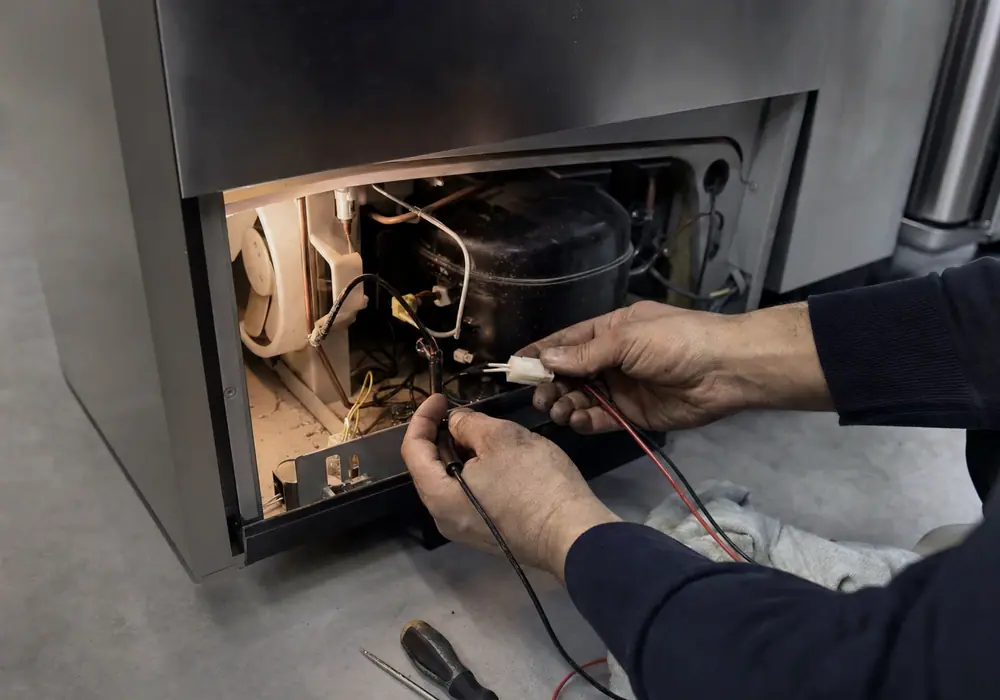
Fine every morning, warm by five, all through August. Two other outfits told me the compressor was going and quoted me a replacement. He measured at the coil instead of reading the panel and found the condenser fan slowing plus our grille half boxed in from the remodel.
The cubes had been getting smaller and half hollow for a year before I called. He put a gauge on the water valve before anything came apart, found scale in the screen and up the fill tube. Said a new module would have left me right where I started.
Appliance down in San Diego?
Tell us the brand and what it is doing — we can usually name the likely repair before we arrive.
Questions
Answers before you call
Are the parts original, or aftermarket?
OEM only, sourced from authorized suppliers, so the appliance stays factory-spec. A pattern evaporator fan or a generic thermistor will usually run for a season and then put you back at the same fault, having paid twice for one repair. If a part has to be ordered you hear its name and its cost before the order is placed, not when the invoice arrives.